
Showing posts with label The Oatmeal. Show all posts
Showing posts with label The Oatmeal. Show all posts
Monday, 24 June 2013
The elusive oatcake.
We would like to thank Seb Emina & Malcomb Eggs, authors of the 'The Breakfast Bible' for inspiring this blogpost and letting us borrow this fantastic recipe. We've added a Rude Health twist.
Nobody knows how the Staffordshire oatcake really came about. It tastes nothing like its Scottish counterpart. In fact the Staffordshire sort has changed my perception of what an oatcake is meant to be. It has the texture of a moist crumpet/pancake amalgamation, and tastes seriously (deliciously) oaty.
Some say that the Staffordshire oatcake came from India? Apparently the men of the North Staffordshire Regiment developed a taste for chapattis during their time there. When the men returned, they tried to duplicate the chapattis they had enjoyed but using local ingredients–and the Staffordshire oatcake / ‘chapatti’ was born.
The more credible story is that when the Industrial Revolution arrived, there was a boom in the number of hungry potters in the Stoke-on-Trent area so rural cooks had to make the most of the local Pennines oats.
The exact recipe varies between oatcake shops and was for many years a closely guarded secret. There would be an oatcake shop on nearly every street corner years ago. Not just selling the oatcakes but also hot filled oatcakes. The sale of these flat oaten pancakes became a thriving industry, with oatcakes being sold out of holes in the walls of city kitchens. This was British street food before the Golden Arches came about.
Nowadays the Staffordshire dinner-plate-sized oatcake is very hard to find, but it is possible to make a good approximation at home, using wholemeal flour, fine-ground oatmeal, yeast, water and milk.
It seemed obvious to try and incorporate Nick’s oatmeal into this recipe. Finding and developing recipes with which we can use our foods has become a bit of an obsession here at Rude Health. We have come up with quite a few and are sharing them all on our new recipe page.
To get you started, here’s the Rude Health version of the Staffordshire Oatcake using no more than five ingredients. ♯counton1hand
This recipe makes 6 oatcakes
Ingredients
110g Rude Health Oatmeal
110g wholemeal flour
½ teaspoon salt
½ teaspoon sugar
3.5g (a half sachet) dried instant yeast
210ml warm milk
210ml water
Method
1. Mix all the dry ingredients in a large bowl, and add the liquids.
2. Whisk until you have a smooth batter the consistency of double cream. It will seem a little thin, but the oatmeal will swell, making it thicker.
3. Leave it covered with a clean tea towel in a warm place for 1 hour, until the batter is thick and frothy.
4. Heat a heavy-based frying pan over a medium heat, and coat the surface of the pan with oil, using a piece of kitchen paper to wipe off any excess.
5. Add one ladle of mixture, and tilt the pan so that it is evenly spread. Cook for 2–3 minutes on a medium heat, until the surface is covered in bubbles and the underside is brown. Flip and cook for another 2–3 minutes. Keep an eye on the heat, as the oatcakes need to cook through without burning.
6. Serve hot, rolled around the filling of your choice. If you have any spares they will reheat well between two plates over a pan of boiling water.


Wednesday, 1 May 2013
Pillage and Porridge
We’ve had a busy April at Rude Health, with all sorts of exciting things under-way, and I’ve even been lucky enough to get away for not just one, but two holidays.
Over the long Easter weekend I escaped up to Northumberland, to spend time with rest of the Poples and to fill our lungs with the fresh country air. We spent the weekend trekking along Hadrian’s Wall and catching up over well-earned feasts. Up on the Wall (cue Game Of Thrones reference) the views were incredible, with nothing around us but wildlife and unusually for April - snow! It didn’t feel like spring was anywhere in sight. Unsurprisingly, we later found out that it was the coldest Easter on record.

We also paid a visit to the archaeological site of an ancient Roman military post, called Vindolanda. At this ancient Roman town, so much has been uncovered that you can walk through the streets, into the old pubs and even set foot into a Pre-Hadrianic bathhouse. There was also a spectacular museum displaying their findings of perfectly preserved leather shoes, jewellery, armour and cutlery. The fork hadn’t been invented but the spoon had so they could fuel up on a hearty bowl of porridge before battle – thank goodness!


We also paid a visit to the archaeological site of an ancient Roman military post, called Vindolanda. At this ancient Roman town, so much has been uncovered that you can walk through the streets, into the old pubs and even set foot into a Pre-Hadrianic bathhouse. There was also a spectacular museum displaying their findings of perfectly preserved leather shoes, jewellery, armour and cutlery. The fork hadn’t been invented but the spoon had so they could fuel up on a hearty bowl of porridge before battle – thank goodness!

After just a few days back in the office, I was off again, this time to Bergerac, France. I was hoping to relax in the warmer weather with my family and indulge in cheese and wine aplenty. But things didn’t quite turn out as hoped - best-laid plans and all that. Instead, we were graced with all sorts of unexpected extras, which certainly made this holiday a memorable one!
On our first day, just after packing up the car with our week’s food, we suddenly realised that the keys to the car had been packed up, along with our food. Great start. There was talk of breaking a window to get to them, but fortunately, with sheer determination and a stroke of ingenuity, the situation was resolved without even a scratch on the car. How? Well, a magician never reveals her secrets.
After calming down from the afternoons excitements, we took the dog for an evening walk and had a hearty supper of Green Lentil and Merguez Sausage Casserole – delish. Unfortunately however, the key incident wasn’t the only ‘extra’ we had in store. The next day my mum, brother and I all woke up with flu. To follow that, the dog cut his foot open. My mum twisted her ankle. And the trailer broke. We weren’t having much luck!
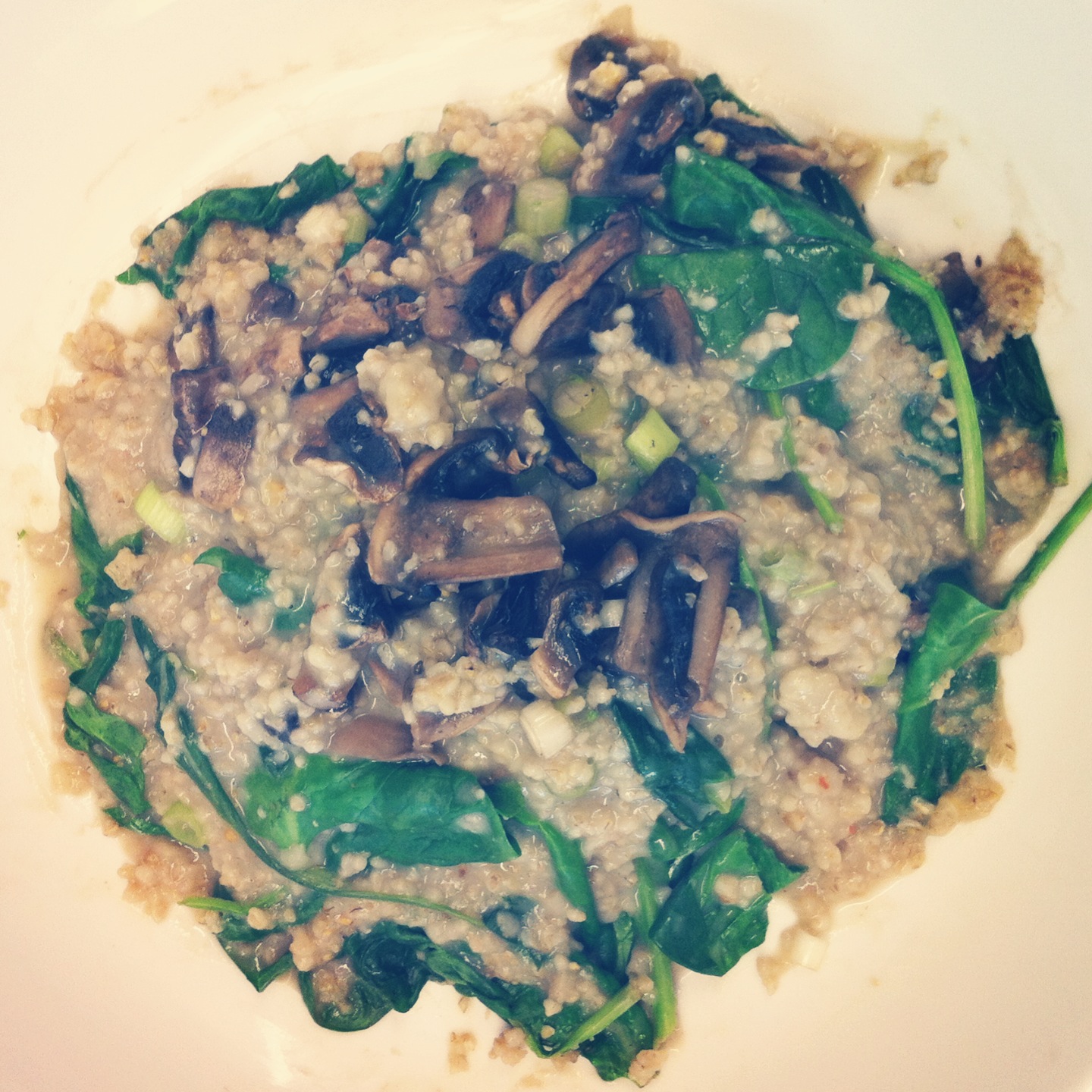
As we weren’t feeling up to our usual French feasts, I thought I would bring us a little comfort in the form of Congee. Congee is a type of rice-porridge that is popular in many Asian countries and eaten especially when feeling ill. I gave it a Rude Health twist and switched the rice to The Oatmeal. There are all sorts of different variations of Congee but I kept it simple using chicken stock, fresh ginger, mushrooms and spinach. Savoury porridge may sound a little unusual but this ‘Oatmeal Congee’ was really comforting and delicious. Here is the recipe I used (I use very rough measurements so adjust to your taste):


Aside from our holiday not being quite what we expected, our spirits were not dampened. We had a fantastic time together and there was at least, some warmer weather!


Aside from our holiday not being quite what we expected, our spirits were not dampened. We had a fantastic time together and there was at least, some warmer weather!

Until next time...
Thursday, 31 January 2013
How to make Oatmeal Porridge...
Not all porridge is created equal. Yes oatmeal does take a little more time and effort than porridge flakes, but it's worth it. Once you've tasted the comforting, rich, oaty smoothness, and felt the generous, sustaining energy from a bowl of well-made oatmeal, you'll be hooked.
Why does it take longer to prepare? Because oatmeal is not a flaked grain. Unlike the steamed and rolled quick oat flakes - a late 19th Century invention - oatmeal is the oat groat (grain) cut into 3 (pinhead) or crushed (coarse/medium/fine grades). The Oatmeal has a blend of organic steel cut pinhead and medium oatmeal.
Cooked with water and sea salt, oatmeal porridge is the original oat porridge and with a little help from traditional methods and some practice it's easy and quick to make.
1. I begin in the time honoured way with an evening ritual, for which you'll need oatmeal, water, kettle, a bowl and a measuring cup - this one is 100ml. Here I'm making enough for Max (7), me and Camilla

2. Pour about 150ml of oatmeal into a bowl - making porridge is not a precise process
3. Warm some water, so it's tepid, not scalding. Add about 200ml of the warm water to the oatmeal and mix well. It'll look like a rich soup. Take a moment to smell your soaking oatmeal - it should have a wonderful, soothing velvety aroma. Put to one side overnight covered with a plate. Don't worry about where you put it - it doesn't need any more warmth.


4. By the next morning your soup will have set - the oatmeal has soaked up most of the water, and in doing so is now ready for cooking in less than 5 minutes.

5. Boil about 200ml of water with two pinches of good quality sea salt, and then tip in the soaked oatmeal and stir. Turn the heat down a little and let the oatmeal come to a simmer, stirring from time to time. At first the oatmeal will look very watery, but within moments it will begin to thicken as the grains soak up yet more water.


6. Reduce the heat so that oatmeal bloops and pops a little. With confidence and a low heat, you can put the lid on and let the oatmeal steam. For now, leave the lid off, and after a minute or so, taste for salt, and if the oatmeal is too thick add a little water at a time, and if you need salt add it now too, and then taste again after a good stir.

7. Keep stirring and tasting, checking for texture, bite, and saltiness. I like my oatmeal with a subtle hint of salt and a nourishing rich texture that I can pour slowly from the pan into a bowl.

Max and Camilla have maple syrup with theirs, and I like Irish apple syrup and a sprinkle of bee pollen. A melty topping of coconut oil or some home made ghee is good too. However we all like Guernsey raw cream from Hurdlebrook…Max and I share a bowl of this custard like luxury and take a scoop of the cold cream with a spoonful of oatmeal. Such a simple yet exquisite pleasure that's rooted in a crofting tradition: cream from the milk cow to share in the centre of the family breakfast table, and a bowl of oatmeal each. Perfect.

I'll be taking The Oatmeal to the The Golden Spurtle (World Porridge Championship) this year. In 2011 and 2012 it secured me a place in the final. This year I intend to win with it. Practice makes perfect.
Subscribe to:
Posts (Atom)